Wednesday, 5 January 2022

THE RAPE OF THE LOCK

The Rape of The lock


Hello readers! This blog is written  as our classroom task based on the poem  THE RAPE OF THE LOCK  written by Alexander Pope. Here answers are given to some questions about this particular poem.


I am giving to  YouTube video  about this particular poem you can understand easily  the story of poem.


QUESTIONS AND ANSWERS 


ACCORDING TO YOU WHO IS THE PROTAGONIST OF THE POEM CLARISSA OR BELINDA?  WHY?  GIVE YOUR  ANSWERS WITH LOGICAL REASONS. 


   "Beauties in vain their pretty eyes  may roll; charms strike the sight , but merit wins the soul." 


THE RAPE OF THE LOCK written by Alexander Pope. The first published in 1712. This is mock heroic narrative poem. The final form of the poem appeared in 1717 with the addition of clarissa speech on good humour. The poem was much translated and contributed to the growing  popularity of mock -heroic in Europe. 


According to me the protagonist of the poem is Belinda.  She as a representative lady of the 18th century  England.  Pope has presented Belinda as a complex character. He has presented her in different roles and under different shades, some  are satirical  other ironical but all entertaining.  The character of Belinda has created much controversy since the publication of the poem. Some critics consider her treatment fair while others as unfair.


There are several aspects of the personality of Belinda as portrayed by Pope in The Rape of The lock.  It will be wrong to regard her purely as a goddess, or as a pretty spoiled child, or as a flirt. She is a combination of all three and yet much more than such a combination.  We see her as a vamp, an injured innocent, a sweet charmer, a society Belle, a rival of the sun, and a murderer of millions.  She  has a cleopatra like variety. However, the reality lies in between these two extremes we can discuss her character as blow.


Belinda is the heroine of the story.  It is her character around whom the story of the whole poem is woven. We see her sleeping till noon and her awakening by her lap dog Shock. Then we see her proceeding from the Thames River to the Hampton Court. Then her smiting looks upon the well dressed youths that crowds her. Pope compares Belinda to the sun and suggests that it recognized in Belinda a rival. Belinda is like the sun not only because of her bright eyes and not only because she dominates her special world. She was as beautiful as every eye was fixed on her alone. She is like the sun in another regard.


Belinda is a model arid more specifically represents the fashionable, aristocratic ladies of Pope's age. Such social butterflies in eighteenth century were regarded as petty trifles, having no serious concern with life, and engrossed in dance and gaiety. Belinda fall indicates the decadence of her class. Though her, describes the flippancy and depravity of the English society of his day.


Pope attitude to Belinda is very mixed and complicated; mocking and yet tender, admiring and yet critical. The paradoxical nature of Pope's attitude is intimately related to the paradox of Belinda situation. If Belinda is to find her role of woman, she must lose the role of a Virginia, and the more graceful her acceptance of loss the greater  the victory she achieved through it. Because Pope is dealing with this paradox, his altitude must be mixed and complicated. It is necessary for Pope to stress Belinda divinity. At the same time he does not let us forget Belinda mortality.  He qualifies her goddess ship by emphasizing human qualities. The scene at Belinda dressing table, where she is both mortal priestess and the goddess worshipped in the mirror, is an example of this device. The very frailty and transients of blushes and chastity emphasize this goddess  humanity.


Sunday, 2 January 2022

The Importance of Being Earnest

 The Importance of Being Earnest  play by Wilde

The Importance of Being Earnest, in full The Importance of Being Earnest:A Trivial comedy for Serious people, play in three acts by Oscar Wilde, performed in 1895 and published in 1899. A satire of Victorian social hypocrisy, the witty play is considered Wilde greatest dramatic achievement. 

Oscar Wilde 


Oscar Wilde, in full Oscar Fingal O' Flahertie wills Wilde, Irish wit, poet, and dramatist whose reputation rests on his only novel, The picture of Dorian Gray (1891),  and on his comic masterpieces Lady Windermere's Fan (1892) and The Importance of Being Earnest (1895). He was a spokesman for the late 19th century Aesthetic movement in England, which advocated art for art's sake, and he was the object of celebrated civil and criminal suits involving homosexuality and ending in his imprisonment (1895-97).

Character of play 

Jack  worthing /Earnest 

The play protagonist.  Jack  worthing is a seemingly responsible and respectable young  man who leads a double life. In Hertfordshire, where he has a country estate, Jack is known  as Jack.  In London he is known as Earnest.  As a baby, Jack was discovered in a handbag in the Victoria Station by an old man who adopted him and subsequently made Jack Guardian to his granddaughter, Cecily Cardew. Jack is in love with his friend Algernon's  cousin,  Gwendolen Fairfax.  The initials after his name indicate that he is a justice of the peace.

More than any other character in the play, Jack worthing represents conventional Victorian values; he  wants others to think he adheres to such notions as duty, honor, and responsibility, but he hypocritically flouts those very notions.  Indeed, what Wilde was actually satirizing  through Jack was the general tolerance for hypocrisy in conventional Victorian Morality.  Jack uses his alter- ego Earnest tohis honorable image intact. Ernest to enable Jack to escape the boundaries of his real life and act as he wouldn't dare to under his real identity.  Earnest provides a convenient excuse and Disguise for Jack, and Jack feels no qualms about invoking Ernest whenever necessary.  Jack wants to be seen as upright and moral, but he doesn't care what lies he has to tell his loved ones in order to be able to misbehave. Though Ernest has always been Jack unsavory alter ego, as the play progrsses Jack  must aspire to become Earnest, in name if not behavior.  Until he seeks to marry Gwendolen, Jack has used Earnest as an escape from real life, but Gwendolen Fairfax on the name Earnest obligates Jack to embrace his deception in order to pursue the real life he desires. Jack has always managed to get what he wants by using Ernest as his fallback, and his lie eventually threatens to undo him. Though Jack never really gets his comeuppance, he must scramble to reconcile his two worlds In order to get what he ultimately desires  and to fully understand who he is.

Algernon Moncrieff


The play's secondary hero. Algernon is a charming, idle, decorative bachelor, nephew of Lady Bracknell, cousin of Gwendolen Fairfax, and best friends of Jack worthing, whom he has known for years as Earnest.  Algernon is brilliant, witty, selfish, amoral, and given to making delightful paradoxical and epigrammatic pronouncements. He has invested a fictional friend, "Bunbury", an invalid whose frequent sudden relapses allow Algernon to wriggle out of unpleasant or dull social obligations. 

Gwendolen Fairfax 

Algernon cousin and lady Bracknell's  daughter.  Gwendolen is in love with Jack, whom she knows as Earnest.  A model and arbiter of high fashion and society, Gwendolen speaks with unassailable authority on matters of taste and Morality.  She is sophisticated, intellectual, cosmopolitan, and utterly pretentious. Gwendolen is fixated on the name Earnest and says she will not marry a man without that name.

Cecily Cardew 

Jack's ward, the granddaughter of the old gentleman who found and adopted Jack when Jack was a baby. Cecily is probably the most realistically drawn character in the play.  Like Gwendolen, she is obsessed with  the name Ernest, but she is even more intrigued by the idea of wickedness.  This idea, rather than the Virtuous- sounding name, has prompted her to fall in love with Jack's brother Ernest in her imagination and to invest an elaborate romance and courtship between them. 

Lady Bracknell

Algernon snobbish , mercenary, and domineering aunt and Gwendolen mother.  Lady Bracknell married well, and her primary goal in life is to see her daughter do the same. She has a list of "eligible young man" and a prepared interview she gives to potential suitors
 Like her nephew, Lady Bracknell is given making hilarious pronouncements, but  where Algernon means to be witty, the humor in Lady Bracknell's  speeches is unintentional. Through the figure of Lady Bracknell, Wilde manages to satirize the hypocrisy and stupidity of the British aristocracy. Lady Bracknell values ignorance, which she sees as " a delicate exotic fruit." When she gives a dinner party, she prefers her husband to eat downstairs with the servants. She is cunning, narrow - minded, authoritarian, and possibly the most quotable character in the play. 
 

Miss prism

Cecily's governess. Miss prism is an endless source of pedantic bromide and cliches. She highly approves of Jack presumed respectability and harshly criticizes his " unfortunate" brother.  Puritan though she is Miss prisms severe pronouncements have a way of going so far over the top that they inspire laughter.  Despite her rigidity,  Miss prism seems to have a softer side. She speaks of having once written a novel whose manuscript was "lost" or "abandoned." Also, she entertains romantic feelings for Dr. Chasuble.

Thank you 

Friday, 31 December 2021

Jude the Obscure

Jude the Obscure By Thomas Hardy


Jude the Obscure is a novel by Thomas Hardy, which begun as a  magazine serial in  December  1894 and was first published in book  form in 1895. It is Hardy last completed novel. The protagonist, Jude Fawley, is a working class young man;  he is a stonemason who dreams of becoming a scholar. The other main character is his cousin, Sue  Bridehead, who is also his central love interest. The novel is concerned in particular with issues of class, education, religion, morality and marriage.

Character  of  Novel 

Jude Fawley

The novel's protagonist, a poor orphan who is raised by his great - aunt after his parents divorced and died. Jude dreams of attending the university at Christminister,  but he fails to be accepted because of his working class background. He is a skilled stonemason and a kindly soul who cannot hurt any living thing. Jude's "fatal flaw" is his weakness regarding alcohol and women, and he allows his marriage to Arabella, even though it is unhappy, to distract himself from his dream. He shares a deep connection with his cousin Sue, but their relationship is doomed by  their earlier marriages, society's disapproval, and  bad  luck.  Jude starts out pious and religious, but by the end of his life he has grown agnostic and bitter.

Jude is Obscure in that he comes from uncertain origins, struggles largely unnoticed to realize his aspirations, and dies without having made any mark on  the world. He is also obscure in the sense of being ambiguous: he is divided internally, and the conflicts range all the way from that between sexual desire and knowledge to  that between two different views of the world. Jude is therefore, struggling both with  the world and with himself. 

He is not well equipped to win. though he is intelligent enough and determined, he tries to force his way to the knowledge he wants. though well -intentioned and goodhearted, he  often acts impulsively on the basis of too little objective evidence. Though he  is unable to hurt an animal or another human being, he shows very little concern for himself and his own survival, often needlessly sacrificing his own good. He never learns, as phillotson  finally does perhaps too late, to calculate how to  get what he wants. In short,  he is more human than divine, as Hardy points out.

He is obsessed with ideals. Very early he makes Christminster into an ideal of  the intellectual  life, and his admitted failure there does not dim the luster with which it shine in his imagination to the very end of his life. He searches for the ideal woman who will be both lover and companion, and though he finds passion without intellectual interests in Arabella and wide interests  but frigidity in Sue he maintains the latter as his ideal to his deathbed. Recognizing the christminster holiday just before he died, Jude says, 
               "And I here. And Sue defiled!"

Jude is reconciled to his fate before he dies only in the sense that he recognizes what it is. In a conversation with Mrs. Edlin hesays that perhaps he and Sue were  ahead of their time in the way they wanted to live. He does not regret the struggle he has made,at the least, as he lies ill he tries to puzzle out the meaning of the life. At the very end, however , like job he wonders why he was born. But then so perhaps dose every man, Hardy seems to imply.  


Sunday, 26 December 2021

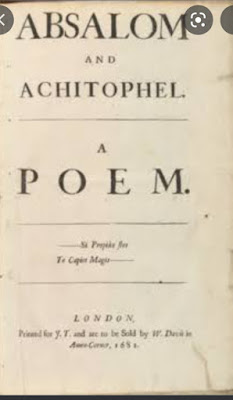
Absalom and Achitophel

 Absalom and Achitophel


Absalom and Achitophel  is a celebrated satirical poem by John Dryden, written in heroic couplets and  first published in 1681.  The poem tells the Biblical tale of the rebellion of Absalom against king David; In this context it is an allegory  used to represent a story contemporary to Dryden,  concerning  king Charles 2 and the Exclusion crisis.   The poem also references the popish plot and the Monmouth Rebellion.  


"Absalom and Achitophel " includes more than 1, 000 poems.  For all that , the poem is not finished: the second part was written by Nahum Tate, with Dryden himself written no more than a few poems. These poems allegorically  depict the political struggle in England at that time. For example, the Biblical legend of the rebellious son of king David  serves as an allegory for the history  of the struggle of the whigs, led by lord sheftsberri against  the so - called "catholic conspiracy." 


Character of Absalom and Achitophel 


Absalom 


David's illegitimate son and the protagonist of the "Absalom and Achitophel." David does not have any legitimate heirs to the throne, but Absalom is his favorite child. Absalom is handsome and ambitious, and he has made himself a hero at war.  The people of Israel love Absalom almost as much as David does, and Achitophel believe that the Jews would accept Absalom as their king.Achitophel begins to encourage Absalom and herald his birth and blood as royal, and he tries to convince Absalom to rebel against David. Absalom, however, is not a malicious man, and he doesn't initially believe he has a right to the crown,  but he is eventually worn down by Achitophel flattery and his own growing desire for more power.  Absalom agrees to rebel against David, and as he travels lsrael in a procession with Achitophel, Absalom  conforms to Achitophel deceitful ways. Absalom and Achitophel mistakes David's mercy and good nature for weakness, but David soon loses patience with both Absalom and Achitophel.  David asserts his power as king before the people of lsrael and effectively  shuts down Absalom rebellion, but Dryden never does say what become of Absalom.  Absalom metaphysically  represents Charles 2 illegitimate son James Scott,   the 1st Duke of Monmouth, who rebelled against Charles and the throne in Dryden time.  Through the character of Absalom,  Dryden ultimately  argues that Charles and his brother James both have a divine right to the crown that is not expected to Monmouth.   Dryden  depiction of Absalom implies that Dryden does not think Monmouth a wholly terrible person, but  someone who is merely tempted and blinded by power; however, Dryden also suggests that Monmouth common birth automatically excludes him from ascending the throne.   Dryden argued through  Absalom that Monmouth play to power, specifically his attempt to seize a position of power that rightfully belongs to another, is a sin against God. Dryden   doesn't  entirely  denounce Absalom ambition, but  he does argue that usurping the  throne is completely unethical. 


Achitophel 


A deceitful  counselor to king David and the antagonist of "Absalom and Achitophel." Of all the man  who oppose David within the government, Achitophel is the most influential.  He is smart, ambitious, and morally flexible.  He pretends to be David's friend, but in actuality, he either wants to rule lsrael or completely destroy it. Achitophel stokes the " malcontents " of the Jews and incites anti -Jerusite hysteria in an attempt to ruin David, and then he encourages David son Absalom to rebel against him.  Absalom  hates David's brother, the Heir presumptive, and  he wants to make sure that he never ascends the throne.  Achitophel begins his plan to ruin David  by claiming David is a Jerusite, and his approach proves very  effective.  As Achitophel works on Absalom, Achitophel trusted men wreak havoc with the Sandestin and try to  bring David down from inside the government. Achitophel finally convinces Absalom to rebel, and they embark on  a procession through Israel to further  ingratiate  Absalom with the people and identify enemies to their cause.  However, Achitophel has mistaken David mercy and mild temper for signs of weakness, and when David finally loses his patience, Achitophel is reminded of David divine power.  Dryden's Achitophel represents Anthony Ashley Cooper, the 1st Earl of Shaftesbury, a Member of parliament during Dryden  time and the main supporters of the Exclusion Bill. What comes of Achitophel is never revealed in Dryden's poem, but historically speaking, shaftesbury was tried for treason after encouraging Charles son the Duke of Monmouth, to rebel against the crown, but he was  later acquitted.  Through Achitophel, Dryden suggests that Charles and James both have just claims to the throne and is not for shaftesbury, Monmouth, or parliament to infringe on that power. 


David


The third king of lsrael.  David is a merciful  and  kind king who does not have a male heir to inherit the throne.  As such, the crown will ascend down a "collateral line" after David death to his brother. As he has many mistresses, David also gas several illegitimate sons, but he loves Absalom the most, and the people of lsrael likewise love Absalom and herald him as a national hero.  Dryden David is an allegory for king Charles 2 of England, and like David,  Dryden argued that  Charles has a divine right to the throne, which Charles son, the Duke of Monmouth tried to  usurp in Dryden time.  Dryden was an ardent supporter of the monarchy and Charles 2,  and his portrayal of  David in "Absalom and Achitophel " reflects this support, but he does not depict David as perfect.  


Minor character 


Balaam 


One of Achitophel men. Balaam is a prophet in the Bible, and in "Absalom and Achitophel " he represents Theophilus Hastings, a Member of parliament and proponents of the Exclusion Bill.


Caleb 


One of Achitophel men. Caleb is a spy in the Bible, and in Dryden poem he represents Arthur  Capel, Earl of Essex, a Prominent advocate of the Exclusion Bill.


Nadab 


One of Achitophel men. In the Bible, Nadab disobey God and is consumed by fire. In "Absalom and Achitophel," he represents William, lord   Howard Esrick, a puritan  preacher who supports the Exclusion Bill.


Zadock 


One of David Trusted men. According to the Bible, zadock is the High priest of lsrael, and in Dryden poem he represents  William  sancroft, Archbishop of Canterbury, a supported of Charles 2.


Adriel 


Another of David trusted men. In the Bible, Adrian is a nobleman in lsrael and another of Barzillais sins. In "Absalom and Achitophel " Adrian most likely represents John shuffled, 3rd Earl of Musgrave, who opposed Monmouth  succession to the crown and supported James 2.


Michal /David wife


The queen of lsrael.  Michal is also the daughter of Saul, and she and David have no children.  She represents Charles 2nd wife, Catherine of Braganza ; like David and Michal, Charles and Catherine did not have children  


Thank you 


Wednesday, 22 December 2021

Macbeth

  William Shakespeare play Macbeth


This blog is related to the blog task based on  William shakespeare play  'Macbeth 


Feminist Reading of Lady macbeth 


 In Shakespeare's play Macbeth, he presents the conflicting character of Lady Macbeth.  Upon receiving her husband's letter about the witches prophesies, she attempts to be like a man in order to exude the strength needed to gain additional social status as royalty.  Lady Macbeth appears to be very influential in planning - deciding when and chiding her husband for not acting more like a man; yet, despite these capabilities, she is the main reason for the revealing of the Macbeth's part in the usurpation of the throne.


According  to materialist feminism theory, despite her earlier show of strength, Lady Macbeth eventual weakness is a result of a patriarchal portrayal of her gender. 


A  popular speculation on why the oppression of women is not more commonly recognized than the oppression of certain ethnic or religious groups, is that "women's allegiance to men from their own always supersedes their allegiance to women from different classes." While certain social and economic factors separate people from different walks of life,  within these groups women are  also separated from each other. Women remain isolated which prevents them from making significant changes because they have no strength in size.


Similarly, Lady Macbeth, while being notably strong  compared to other members of her gender, gas no way to enact her schemes as she is kept isolated from other women during the course of the play. While her strength is great, she is not powerful enough alone to deal with a murder.  She does not reveal the secret of their murderous deeds because she is a woman and thus inherently weak,  but she reveals the secrets  because she is a woman and thus has been selectively isolated from finding strength in number. 


 From the very beginning of Macbeth, Lady Macbeth  is shown as a character is relents in creating rebellious plots.  According to Lois Tyson, " women  themselves..in the accomplishment of their husbands and  sons."  Lady  Macduff-  the epitome of  motherhood - does not concoct some evil plot because she invests all of her intellectual powers into the achievement of her husband and children. 


On the other hand, Lady Macbeth, not as bound to domestic duties as Lady Macduff, sharpens her intellectual capabilities for her own use. While intelligence form a male character would be seen as a beneficial trait, patriarchy defines Lady Macbeth intelligence as a flaw and as an indicator that she is unnatural and "unfulfilled " as a woman. 


Patriarchal society encourages Lady Macbeth to invest herself in the role of mother.  Lady Macbeth is seen as selfish and abnormal when she confesses that there is a situation when she would "brains out," a very unnatural statement according to patriarchy beliefs that women's desire to have and protect children is a part of "their natural  biological makeup." Though intelligent and strong at the beginning of Macbeth, Lady Macbeth is reduced to an insignificant person haunted by nightmares and guilt as a result of a patriarchal portrayal of her gender.


This video of character analysis of Lady Macbeth 


Thank you 

Sunday, 19 December 2021

Literary Characteristics of Victorian Age

 Assignment: literary Characteristics of Victorian Age 


Paper No  : 105 History of English literature form 1350 - 1900

 Topic : literary Characteristics of Victorian Age 

Name : Sangita Kantariya 

Roll No : 20 

Enrollment No: 4069206420210015

Semester : 01

Year : 2021-22 

Submitted by : S.B. gardi 

   Department of English, MKBU 


Introduction


Victorian period is one of the remarkable periods of English literature.  It is named according to Queen Victoria. It is said that the Victorian period is the second Renaissance of England.  We get sundry Characteristics of this era such as the conflict between science and Religion, imperialism, industrialization, materialistic  outlooking, adventure, presence of women in all sectors, the domination of novels but fluency of poetry, and so on. 


Literary Characteristics of Victorian Age 

The Conflict Between Science and Religion 


Main features of this era that is the  Conflict between science and Religion.  In this period, science was expanded so much. All men of this era were moving away from Religion.  At that time Charles Robert Darwin wrote a scientific book, "On the Origin of Special."  Darwin suggested that men are originated from monkey.  This kind of theory and scientific  invention moved away from the faith of people from religion to other sides. 


Imperialism 


Imperialism was expanded in the Victorian Age. Imperialism means a policy of extending a country  power and influence through  colonization.  Asia and Africa were ruled by the force of Imperialism.  We get its description in "Heart of Darkness " (1899)  by Joseph Conrad . In this novel, the dark sides of Imperialism have been described. 


Industrialization 


Industrialization is a feature of the victorian period.  In this era, the industry was expanded by the hand of scientific invention.  Many factories were rapidly created in this age.  Victorian society was attracted by Industrialization.  Industrialization  created social classes like Lower class, middle class, and upper class in society.  All the figures of the victorian era express their opinion about  Industrialization.  Alfred, lord Tennyson  pointed out it in "Locksley Hall." Charles Dickens  pointed out it in "Oliver Twist ", " Hard times " , "A Christmas Carol." 


Excessive Meterialism 


Materialistic outlooking is a feature of the victorian period. In this period, all men were groaning toward collecting wealth. We get its description in contemporary writers writing.  Alfred, lord Tennyson pointed out it in "Locksley Hall." George Eliot  pointed out it in " Silas marner." Charles Dickens pointed out it in "Great Expectations."


Adventurous life


Adventure is a feature of the victorian period.  Adventure means an unusual, exciting, or daring experience.  In this period, all men loved adventure.  We get its description in  Alfred, lord Tennyson  poem , "Ulysses " , Matthew Arnold's poem, " The scholar gypsy" , Lewis Caroll's novel , "Alice's Adventure in wonderland."


Contribution of women in all sectors 


Women position in all sectors is a feature of the victorian period.  In this period, women were active in literature.  They wrote some prominent novels, essays, poems, etc like male figures. According to critics, Charles Dickens is the king of the Victorian novels. But a female novelist surpasses the popularity of Charles Dickens.  Her name is Ellen wood and her famous work is "East Lynn."  She was a very popular figure because of her sensation novel. It means melodramatic representation. 


Domination of novels 


Domination of novels but fluency of poetry is also a feature of the Victorian period.  This age is Dominated by novelist but poets are not less than novelists. According to critics, the  Victorian Age is the age of novels.


Achievement 

The Oxford movement 


This movement took place in the nineteenth century.  It was an outcome of a long controversy and ideological conflict amongst different Christian sects and churches and therefore it may be called a religious movement.  It's name was Oxford movement as it was centered at the University of Oxford that sought a renewal of catholic or Roman catholic, thought and practice within the Church of England in opposition to the protestant tendencies of the church.  This movement is also called Tractarianism movement as it was carried throughout the tracts and pamphlets. The origin of the Oxford movement can be traced to the opposition of the scientific discoveries against age old religious beliefs and faiths. The aim of the movement was to rehabilitate the dignity of the church, to defend the church against the interference of the state, to fight against rationalism.


Thank you 

Charles Dickens as Novelist

 Assignment: Charles Dickens as 

Novelist 

Paper No : 104 literature of the victorian 

Topic : Charles Dickens As Novelist 

Name : Sangita Kantariya 

Roll No: 20

Enrollment No: 4069206420210015

Semester: 01 

Year : 2021-22 

Submitted by: S.B. Gardi 

  Department of English, MKBU 


Introduction  

The victorian age


The victorian age is believed to be from 1850 - 1900 when Victoria became queen in 1837 ; English literature seemed to have entered upon a period of lean years in marked contrast with the poetic fruitfulness of the Romantic age.   victorian age is regarded as a very important period of English literature.  Many writers gave their unique contribution in making this age important. 


Salient features 

An era of peace

Conflict between science and Religion 

Material development 

Morality

The revolt 

The new  Education 

International influence  

The Achievement of the age


The victorian era is especially marked because of its rapid progress in all the arts and science and in mechanical invention. This age can be called as the Age of compromise.  In other words, we can say, there was death of agriculture.  Workhouse were getting full as people were in search of job to earn money. 


MAJOR WRITERS OF THE AGE 


ALFRED TENNYSON  (1809-92)

TENNYSON life is a remarkable one in this respect, that from beginning to end he seems to have been dominated by a single impulse, the impulse of poetry.

 poem 

The princess

Dora

The memoriam

Crossing the bar

Plays 

Queen Mary (1875)

Harold (1876)

The falcon (1879)

The cup (1881)

The forester (1892)


ROBERT BROWNING  

He was an English poet and playwright whose mastery of dramatic verse, especially dramatic monologues, made him one of the foremost victorian poets. He is better known today for his shorter poems such as The pied piper of Hamelin and How They Brought the good News from Ghent to Aix. 

Poems 

Parcells

Pauline

Men &women 

The Ring and the book 


CHARLES DICKENS   (1812-70)

 Charles Dickens was the most influential Novelist of this age. More ever he was a social reformer. Dickens is one of our greatest artists.  His many volumes include such works as A Christmas Carol, David Copperfield, Bleak House, A Tale of Tow Cities, Great Expectations, and our Mutual friends. 

Dickens enjoyed a wider popularity during his lifetime than had any previous  author.  His long career saw fluctuations in the reception and sales of individual novels, but none of them was negligible or uncharacteristic or disregarded, and though he is now admired for aspects and phases of his work that were given less weight by his contemporaries, his popularity has never ceased. The range, compassion, and intelligence of his apprehensive of his society and its shortcomings enriched his novels and made him both one of the great forces in 19th century  literature and an influential spokesman of the conscience of his age.


Beginning of a literary career 


Mush drawn to the theater, Dickens nearly become a professional actor in 1832.  In 1833 he began contributing stories and descriptions essays to magazines and newspapers;  these attracted attention and were reprinted as Sketches by "Boz."  The same month, he was invited to provide a comic serial narrative to accompany engravings by a well - known artist; seven weeks later the first installment  of The Pickwick papers appeared. 


Charles Dickens works 


Charles Dickens ĺoved the Gothic Romance of the 18th century.  His writing style was florid, poetic and it had a powerful comic touch. Charles Dickens was famous for his novels  which portrayed the difficult life of the working class and his characters.  The characters like Tiny Tim , Oliver Twist, pip, David Copperfield and many others were so beautiful portrayed as if they really existed. 


Major works  of Charles Dickens like Oliver Twist , Nicholas Nickleby, The old  curiosity Shop and Barnaby Rudge: A TALE of the Riots of Eighty were first written in weekly or monthly installment and were later on printed as books. 


A noted philanthropist, he helped raise funds for charities, such as Great Ormond Street and also helped to set up a home for ' fallen women.' Redemption was  an important aspect of Dickens philosophy and he often criticized harsh and punitive punishment, such as solitary confinement.


Writing style of Charles Dickens


Charles Dickens is one of the most popular writers in English.  In particular, his novels are brimming with colorful and eccentric characters which leave a lasting impression.  He was a keen and observant writer, incorporating the characters that he met and interacted with in his life, adding a touch of fantasy and exaggeration with his vivid descriptive style.


There are various themes which run throughout his writings. Which often reflects various degrees of his own life stories.  Dickens loved the 'rags to  riches stories ,' exemplified by Oliver Twist and David  Copperfield.  He frequently highlights the worst excesses and social evils of Victorian society and highlighted his views in a wonderfully witty way.


Charles Dickens Death 


On 8th June 1870, Charles suffered another stroke. He died the next day, on 9th June at Gads Hill place. 


Charles had expressed that he should be buried at Rochester cathedral in an inexpensive, unostentatious, and strictly private manner but, was instead buried at poets corner of Westminster Abbey.


Assignment : 106 - 20th century Lit-1

  ASSIGNMENT  Paper No : 106, The  20th Century Literature : 1900 to WW1 Topic : Orlando - A Biography by Virginia Woolf’s  Name : Sangita K...